
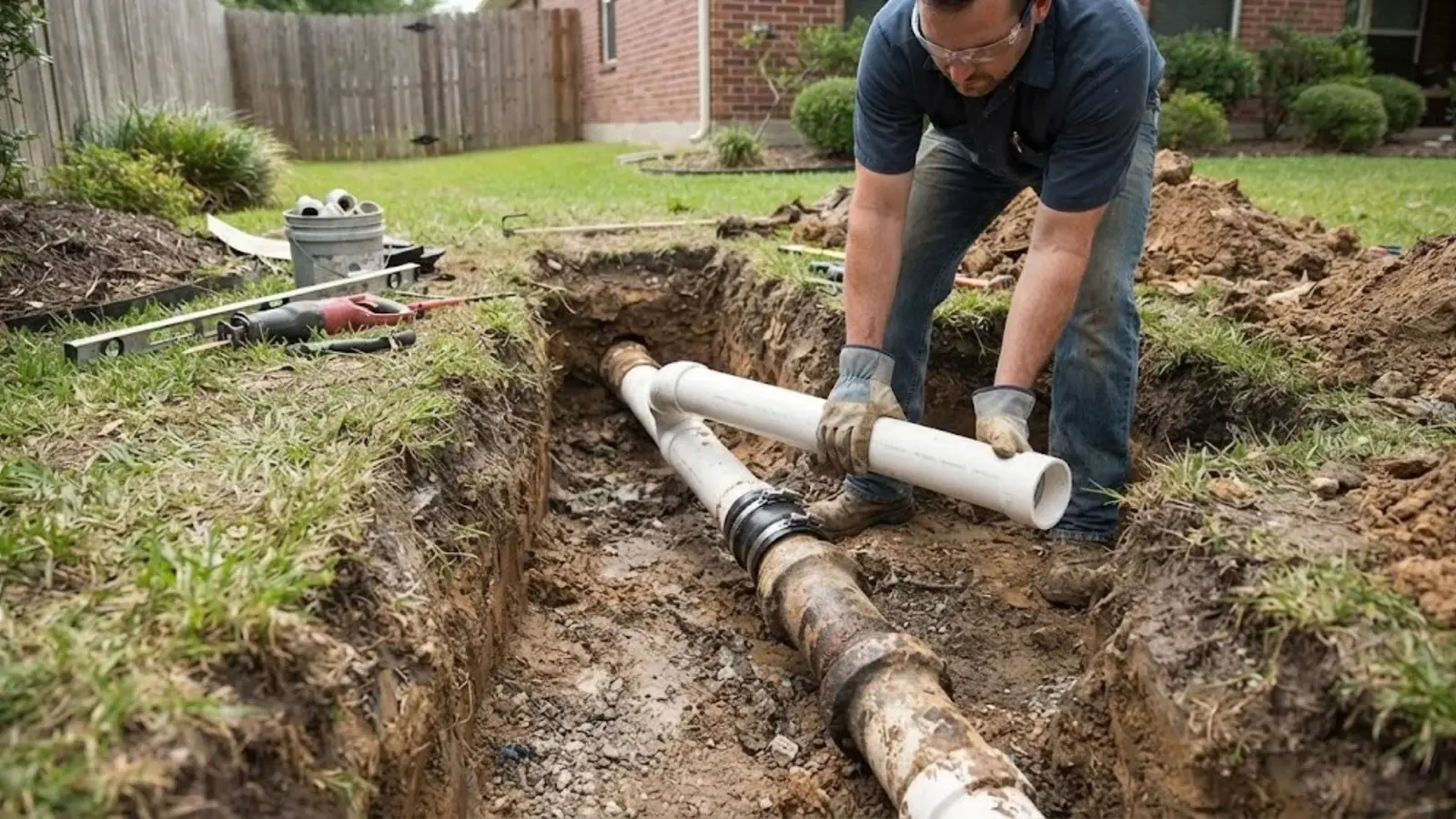
What Is a Sewer Lateral
The lateral runs from your house to the main sewer, often 30 to 100 feet depending on the lot. In older homes it may be clay or cast iron. In newer homes it is typically PVC.
Because it is buried, most owners find out about it when it clogs, backs up or smells.
Signs of a Failing Lateral
Several drains back up together
The lowest fixtures show it first.
Gurgling toilets
Air moving through a partly blocked line.
Sewer smell outside
A cracked pipe lets gas escape.
Wet or sunken ground over the line
A leak is washing out the soil.
Repeated clogs after cleaning
Roots or a belly keep catching debris.
A first-time clog may be a one-off. Two backups within a year deserve a camera look, because the same defect will keep returning.
How Problems Are Diagnosed
A sewer camera on a flexible cable travels from a cleanout through the lateral and records the pipe. It shows roots, cracks, offsets, bellies and scale, and a locator in the camera head marks the depth and path above ground.
The recording lets you see the problem yourself and gives you something to show an insurer or a second contractor.
Buying a Home: Scope the Lateral Before Closing
A standard home inspection usually does not include a camera look at the sewer lateral. A defective lateral can cost thousands, and it is far easier to negotiate before closing than after.
Ask the seller for any record of sewer work, and order a camera scope with a recording. If the camera shows a defect, you can ask for a repair, a credit or a lower price.
Why Roots Find Your Pipe
Tree roots follow moisture. A small leak at a joint releases moist air, and fine roots enter through it. Once inside, they grow, catch paper and form a mass that blocks flow.
Cutting the roots clears the line, but they return unless the joint is repaired or lined. Chemical root killers are of limited use and can harm other plants and the pipe.
A Maintenance Habit That Pays Off
Know where your cleanout is
A capped pipe near the foundation or in the yard is your access.
Flush only paper and waste
Wipes, even labeled flushable, snag in the line.
Keep grease out of the drain
Pour cooled grease in the trash.
Camera the line every few years if it has roots
Early notice keeps a repair small.
If your line is old clay or cast iron, plan for it. Waiting for failure usually means a nighttime backup and a rush job.
Questions to Put to Any Contractor
Ask what the camera showed and whether you can see the recording. Ask why the method fits the defect, how deep the pipe is, how the yard will be restored and whether a permit and utility locate are included.
A clear answer to each of these is a good sign. Vague answers or pressure to decide on the spot are not.
Preparing the Yard and the House for the Work
Before a crew digs or lines a sewer line, clear the path to the cleanout and mark irrigation lines and invisible fences. Tell the crew where any underground utilities run that you know about.
Expect water to be off for part of the day. Plan for showers and laundry around the work, and keep pets inside while the trench is open.
Keep the Paperwork From the Job
Ask for a written description of what was repaired, the footage of the camera inspection if one was done and any permit record. Store them with your home documents.
A repaired lateral with records is easier to explain to an insurer or a buyer later. It also tells the next plumber exactly where the work was done.
Want a camera look at your lateral?
Call and tell us about the backups. We will book a camera inspection.
Repair Methods Compared
| Method | Best for | Tradeoff |
|---|---|---|
| Spot repair | One broken or offset joint | Digs only where needed |
| Trenchless lining | Long runs with roots or cracks, sound alignment | Cannot fix a belly or collapse |
| Pipe bursting | Replace old pipe along the same path | Needs entry and exit pits |
| Open-cut replacement | Collapsed or badly offset pipe | Most digging and restoration |
We recommend the least invasive method that fully solves the problem. A liner in a pipe with a belly just coats the low spot. A full replacement for a single cracked joint spends money you do not need to spend.
Cost Expectations
Typical US figures run from about $1,500 for a short spot repair to $10,000 or more for a long replacement or lining. Depth, length, surface restoration and access drive the number.
Get a written scope that names the method, the length, the restoration and any permit fees.
We serve Chaska, Carver and Chanhassen. If the camera shows a defect, sewer line repair covers the options, and when a main line simply needs clearing, sewer line cleaning is the first step.
Who Owns the Lateral in Chaska
The City of Chaska states that the sewer service line from your property to the City's main is the responsibility of the property owner. The main itself belongs to the City, and wastewater flows to a Metropolitan Council lift station and then to the Blue Lake Wastewater Treatment Facility in Shakopee.
Before digging, call Gopher State One Call at 651-454-0002. If neighbors also have backups, call the City Water and Sewer Department at 952-448-4335, since the main may be the cause.
Source: City of Chaska sewer service line guidance.
Questions Chaska Homeowners Ask
Yes. The City says the service line from your property to its main is the owner's responsibility.
Sometimes, if sudden damage occurs or you carry service line coverage. Gradual wear is often excluded.
A spot repair often takes a day. Lining and full replacement can take several days.
Spot repairs dig small holes. Lining uses small access points. Open-cut replacement digs a trench, and we restore the surface.
Often yes. We handle permits and the utility locate.
Do not flush wipes, keep trees away from the line and have it cleaned or inspected if it backs up twice.