
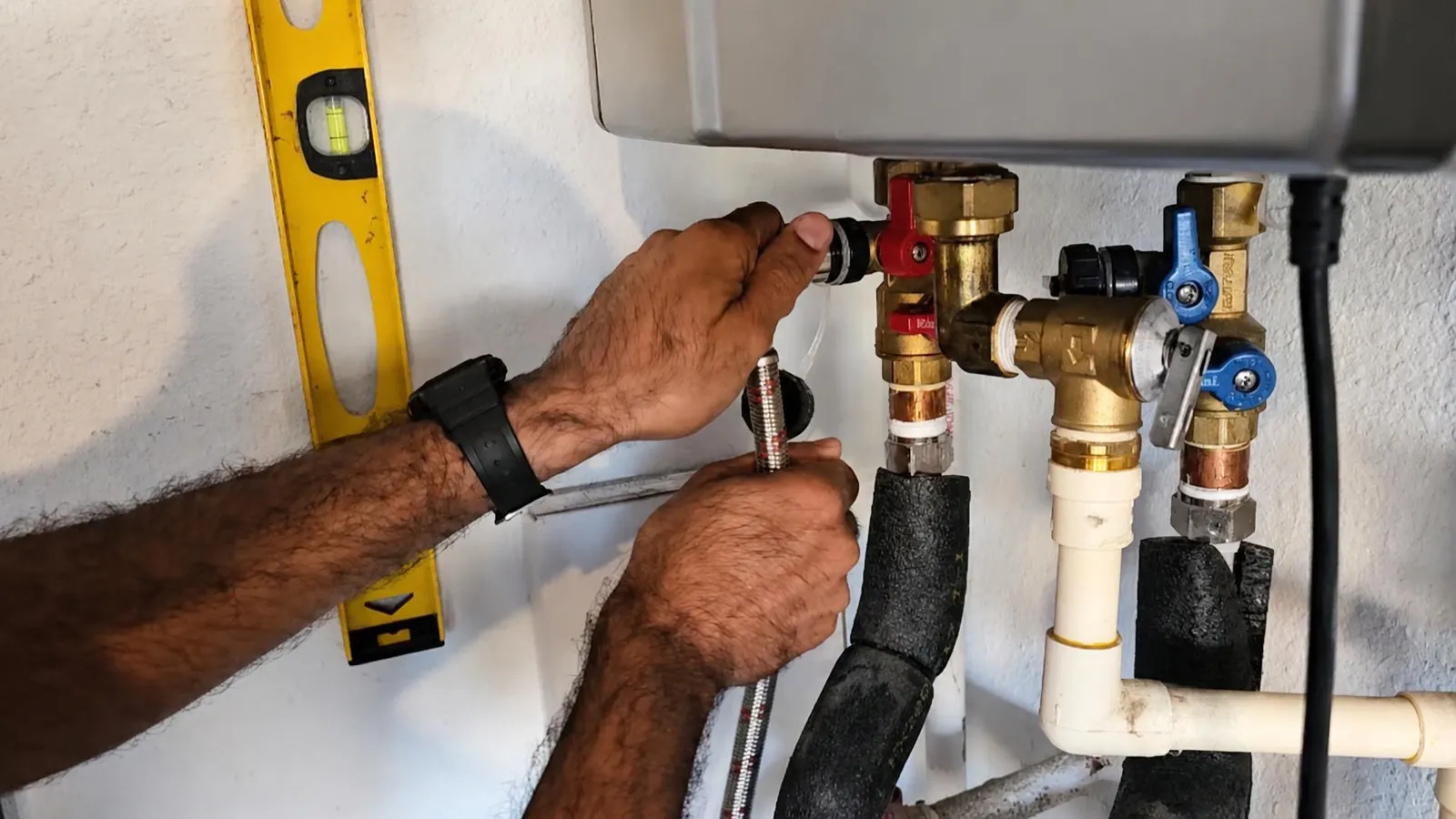
The Real Benefits
Continuous hot water
No tank to empty. Back-to-back showers and a running dishwasher are not a problem if the unit is sized right.
Space saved
A wall-mounted unit frees up a closet or basement corner.
Longer lifespan
Many tankless units last 15 to 20 years with maintenance, compared with 10 to 15 for a tank.
No standby loss
A tank keeps heating water all day. A tankless unit heats only on demand.
Less flood risk
There is no large tank to rupture.
What It Costs
Tankless units cost more to buy and install. The unit itself is pricier, and the gas line, venting and sometimes electrical work add to it. Typical US installed prices commonly range from about $2,500 to $6,000 or more.
Energy savings depend on how much hot water you use and what gas costs. Households that use a lot of hot water see more benefit, and smaller households may take years to recover the extra cost.
| Factor | Tank heater | Tankless heater |
|---|---|---|
| Upfront cost | Lower | Higher |
| Hot water supply | Limited by tank size | Continuous at rated flow |
| Lifespan | 10 to 15 years | 15 to 20 years |
| Maintenance | Annual flush | Annual descale |
| Space | Floor footprint | Wall mounted |
Sizing: Flow Rate and Temperature Rise
Every tankless heater has a maximum flow at a given temperature rise. If groundwater arrives at 45 degrees and you want 120 degrees, the unit must add 75 degrees. A model that delivers 8 gallons a minute at a 50 degree rise may deliver only around 5 gallons a minute at 75.
Add up the fixtures you run at once. A shower might use two gallons a minute, a dishwasher one and a half and a washing machine two. If the total beats the unit's flow at your rise, someone gets lukewarm water.
Maintenance in Hard Water
Descaling once a year keeps the heat exchanger clear. In hard water, skipping it triggers error codes and, eventually, a failed exchanger that costs more than the descale ever would have.
A softener ahead of the unit prevents most of the scale and protects the rest of the plumbing too.
Who Should Probably Stay With a Tank
Small households with low hot water use
The extra cost may never pay back.
Homes with limited gas capacity
If the gas line cannot be upsized economically, a tank is simpler.
Tight budgets for a failed heater
A like-for-like tank gets hot water back fastest and cheapest.
Homes with unusual venting constraints
Some layouts make a tankless vent run very costly.
Venting, Gas and Electrical Checklist
Before a quote is firm, we check the gas meter rating, the line size from the meter to the heater, the venting path to a wall or roof and an outlet within reach of the unit. A condensing model also needs a drain for the acidic condensate it produces.
Skipping any of these checks is how a simple swap becomes an unplanned remodel on installation day.
Living With Tankless Day to Day
Hot water does not arrive instantly. The unit has to detect flow, light and heat the water, then push it through the pipes. Long runs to a far bathroom can mean a wait, and a small recirculation pump can shorten it.
Some users notice a brief cold burst when they turn a tap off and back on quickly. Modern units reduce it, and a small buffer tank can eliminate it. Ask about both when you compare models.
Questions to Ask Before You Commit
Ask what flow rate the unit delivers at a 70 degree rise, what the gas and vent upgrade will cost, how often it needs descaling and what the warranty covers. Ask whether a softener is recommended for your water.
If a quote leaves these out, ask for them in writing.
Want a tankless price?
Call and tell us your household size. We will give you a clear number.
What to Check Before You Switch
Check your gas line capacity, because most tankless units need a larger line than a tank. Check venting options, since tankless units often vent through a wall or roof. Check electrical needs, because the unit needs a power outlet for its controller.
Also check flow. A tankless unit rises in temperature by a set number of degrees at a given flow, so a cold winter incoming temperature lowers the maximum flow.
Minnesota Winters and Tankless
Incoming water in Minnesota winters is much colder than in warm climates, which means the unit has to work harder to reach the same temperature. A unit sized for a warm-climate home may fall short here.
We size by the coldest incoming water you will see, not by an average, so you do not run lukewarm showers in January.
Our tankless water heater service installs, repairs and descales units. We serve Chaska, Victoria and Carver, and if you are replacing a failed tank, water heater replacement compares both options.
Hard Water and Tankless in Chaska
The City of Chaska's 2025 drinking water report lists the water at 26 grains per gallon. Scale builds inside a tankless heat exchanger and narrows its passages, which leads to error codes and lukewarm water.
That makes annual descaling essential in Chaska, and a water softener a smart companion to the unit. The City requires a plumbing permit for water heater installation and replacement.
Gas venting and water connections for a tankless unit follow the manufacturer's instructions and the Minnesota Plumbing Code, based on the Uniform Plumbing Code (UPC).
Source: City of Chaska 2025 Drinking Water Report and plumbing permit information.
Questions Chaska Homeowners Ask
It can, especially in households with modest or irregular hot water use, but savings vary and we do not promise a figure.
Yes, when sized correctly for cold incoming water.
At least once a year, and more often if scale is heavy. A softener helps.
Often. We check before quoting.
Sometimes, but venting and gas often change. We survey the space first.
Most gas tankless units need electricity for the controller and fan, so they will not run during an outage unless on a backup.